Securing Your Trash: Surety Bond Edition

Securing Your Trash: Surety Bonds
Have you ever wondered what happens to your trash after you toss it into the bin? It’s easy to dismiss waste as “out of sight, out of mind,” but the reality is far more complex—and fascinating. Managing waste involves a ballet of logistics, technology, and responsibility to ensure that it doesn’t wreak havoc on our environment. But how can we be sure that everyone involved in this intricate process is doing their job correctly? The unsung heroes here are not just the sanitation workers but also a financial tool you might not have heard of: Surety Bonds. These legal guarantees ensure that each stage of your trash’s journey—from the truck that picks it up, to the transfer stations, and finally to the landfills—is handled responsibly. Read on to discover how surety bonds help secure the lifecycle of your trash, providing a safety net for both our planet and public health.

Types of Landfills
Landfills vary according to the types of waste they handle:
Municipal Solid Waste (MSW) Landfills: These are the most common types and handle household waste.
– Construction and Demolition (C&D) Landfills: These specialize in waste from construction sites.
– Hazardous Waste Landfills: These handle hazardous materials and are subject to strict regulations.
– Industrial Waste Landfills: These are used for industrial waste like ash, slag, and chemical residues.
Each type of landfill requires a surety bond to ensure that they adhere to regulations and have the financial backing to manage waste responsibly.

What Are Transfer Stations?
Transfer stations act as intermediary points where waste from smaller collection vehicles is aggregated into larger vehicles for more efficient transport to landfills. These stations also often sort waste for recycling. Closure bonds are required to ensure that the facility can be safely closed and cleaned when it reaches the end of its operational life.

Waste Hauling Contracts and Contract Bonds
Municipalities often contract out waste hauling services to private companies. These contracts stipulate the terms of service and are backed by contract bonds to ensure that obligations are fulfilled. Should a company default on its service, the bond provides financial coverage for the municipality to find an alternate service provider.

Closure Bonds at Transfer Stations
Closure bonds at transfer stations are necessary to ensure that once a transfer station is no longer in use, it will be closed and cleaned up properly. The bond provides the financial assurance that the facility will be returned to a safe and environmentally stable state.

Landfills and Closure/Post-closure Bonds
Closure bonds are used to ensure that a landfill is properly closed and sealed once it has reached capacity. Post-closure bonds cover the ongoing costs of monitoring and maintaining the site to prevent environmental contamination.

Monitoring at Landfills
Monitoring activities can include water quality testing, gas monitoring, and leachate management. These activities are necessary for detecting any negative impact on the environment, and the cost is factored into post-closure bond requirements.

Corrective Action Bonds
These bonds come into effect when something goes wrong, like a landfill leak. They provide the financial backing for corrective actions, such as cleanup, to be taken quickly and effectively, minimizing environmental damage.

Conclusion
Surety bonds are an indispensable tool in securing the lifecycle of trash. They not only provide financial assurance but also instill a sense of responsibility among waste management companies. By doing so, they play a vital role in safeguarding both the environment and public interests.
 
Our team at Parrot Surety Services is prepared to help you secure a surety bond guarantee for any stage of waste management. Contact any member of our team for dedicated surety expertise and support!
 

Disaster Relief Bonds

Disaster clean-up surety bonds play a vital role in ensuring the smooth and efficient execution of post-disaster recovery efforts. These bonds are a type of financial guarantee that protects the interests of the government, property owners, and affected parties during the clean-up and restoration process. When a natural disaster strikes, such as a hurricane, tornado, or flood, clean-up and restoration companies are often called upon to provide their services. Disaster clean-up surety bonds provide assurance that these companies will fulfill their obligations in accordance with the terms of their contract, including completing the clean-up within a specified timeframe and adhering to safety regulations. In the event that the clean-up company fails to meet these obligations, the bond can be utilized to compensate the affected parties, covering costs for incomplete work or any damages incurred.

If you have any questions on Disaster Relief Bonds or would like a surety professional to help manage and advise your bond program, contact any surety specialist of the Parrot Surety team today!

How are Surety Bonds Classified?

Surety bonds can be classified into various categories based on their purpose and the parties involved. The two primary classifications are contract bonds and commercial bonds.

Contract bonds are primarily used in the construction industry and ensure that contractors fulfill their contractual obligations. Within this category, there are different types of contract bonds, such as bid bonds, performance bonds, and payment bonds. Bid bonds provide financial security to project owners by guaranteeing that the contractor will enter into the contract if awarded. Performance bonds protect the project owner by ensuring that the contractor completes the project according to the terms and specifications. Payment bonds provide assurance that subcontractors and suppliers will be paid by the contractor for the work performed. 

Contract bonds are also used outside the construction industry for service contractors and suppliers. Examples include bus services, lawn services, pest control, waste management services, janitorial services, security services, and more; performance bonds guarantee the performance of their services or supply of materials and equipment and the payment bonds guarantee payment to subcontractors or suppliers.

Commercial bonds, on the other hand, are not specific to the construction industry. These bonds are required by government agencies or regulatory bodies to protect the public interest. They include license and permit bonds, court bonds, public official bonds, and fidelity bonds. License and permit bonds ensure that businesses comply with regulations and fulfill their financial obligations. Court bonds are required in legal proceedings and guarantee the payment of damages in case of a judgment. Public official bonds safeguard against dishonest acts by public officials, while fidelity bonds protect against employee theft and fraud.

 
If you have any questions on Surety Bonds or would like a surety professional to help manage and advise your bond program, contact any surety specialist of the Parrot Surety team today!


What is a Surety T-Listing?

A sureties T-listing (Treasury Listing) is the maximum amount a surety can write for a single bond obligation. Sureties, however, may seek T-Listed reinsurance to qualify for larger amounts than their published T-listing. 
 
Surety T-Listing is a section within the Circular 570, issued by the U.S. Department of the Treasury, which serves as a resource for federal agencies and contracting officers. It includes surety companies that have met the stringent financial requirements necessary to underwrite surety bonds for federal projects. Being listed in the Surety T-Listing assures federal entities that the surety company has the financial strength and stability to fulfill bond obligations, instilling confidence in their ability to honor contracts.
 
To be included in the Surety T-Listing, surety companies undergo a rigorous qualification process. They submit extensive financial documentation and are evaluated based on factors such as net worth, financial statements, claims history, and overall financial stability. Once listed, companies must maintain their financial strength and meet ongoing reporting requirements to remain on the list. The Surety T-Listing is a valuable resource for federal agencies and contracting officers, providing a curated selection of qualified surety companies for federal bonding needs and ensuring the selection of reliable and capable surety providers.
 
If you are working with federal agencies such as the BLM, DoD, USACE, or NAVFAC then you will need to ensure your surety partner has been qualified with the U.S. Treasury Department for the size projects you plan on pursuing. Contact Parrot for peace of mind with managing your bonds or bond programs and matching you with the surety company that best aligns with your size and scope of work.

If you have any questions on how a Surety is rated or would like a surety professional to help manage and advise your bond program, contact any surety specialist of the Parrot Surety team today!


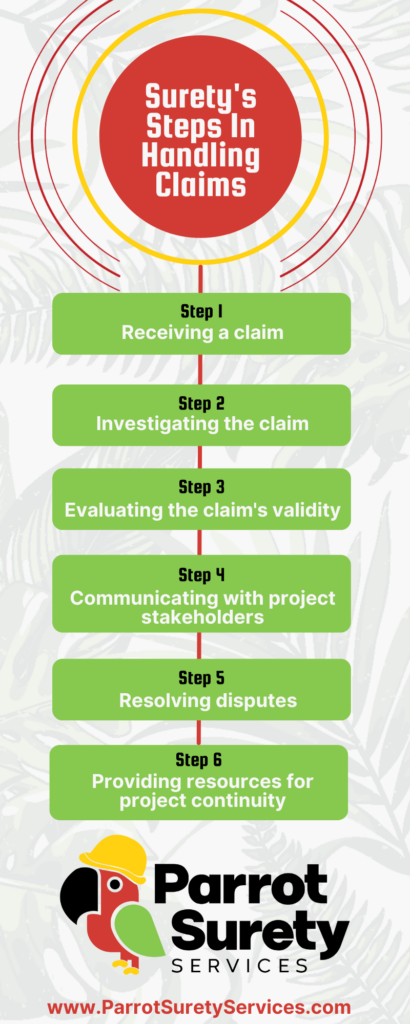
Why Should a General Contractor Be Concerned with The Surety’s Ability to Handle Claims?

As a general contractor, understanding the importance of a surety’s claims department is crucial for the success of your construction projects. A competent claims department helps manage risks and protect your financial interests by effectively handling, investigating, and resolving claims related to contract disputes or failures, including frivolous claims. Their expertise in assessing claim validity, offering timely communication, and facilitating dispute resolution ensures the continuity of your projects and minimizes potential losses. Partnering with a surety company with a strong claims department provides you with the confidence and support needed to navigate the complexities of the construction industry and maintain your reputation for delivering high-quality projects on time and within budget. 

Having a surety agent that has industry knowledge and relationships can help identify and evaluate surety companies that are well-prepared to handle claims efficiently. Parrot Surety Services provides specialized surety expertise and bond program management for contractors of all sizes. We also specialize in complex risks and bonding situations such as high hazard industries, new and emerging contractors, and structured arrangements.  

If you have any questions on how claims are handled or would like a surety professional to help manage and advise your bond program, contact any surety specialist of the Parrot Surety team today!


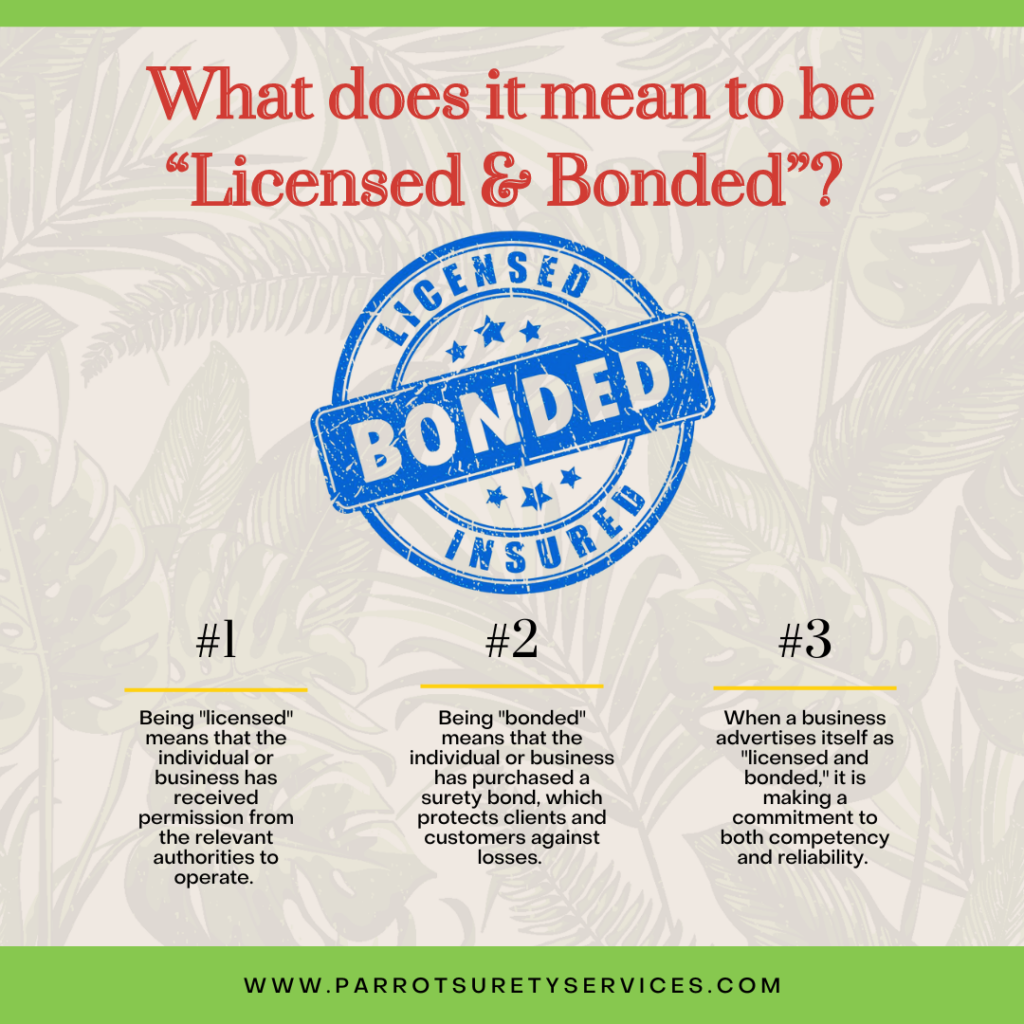
What Does It Mean to be “Licensed & Bonded”?

What Does It Mean to be “Licensed & Bonded”?

In many professions and industries, being “licensed and bonded” is a way to show customers and clients that the business or individual operates at a certain standard of reliability and professionalism. Each of these terms—licensed and bonded—has a specific meaning:

Licensed

Being “licensed” means that the individual or business has received permission from the relevant authorities to operate. This usually involves passing certain tests to prove competency in the field, adhering to specific regulations, and often paying a fee. Licensure is often a legal requirement for professions that have a significant impact on public health, safety, or well-being—such as medicine, law, and various types of construction and repair services.
The licensing process is often regulated by state or federal agencies, and being licensed assures clients and customers that the service provider has met certain minimum standards set by the governing body. These standards can relate to both the skills and knowledge required to do the work, as well as ethical and business practices.

Bonded

Being “bonded” means that the individual or business has purchased a surety bond, which protects clients and customers against losses. These losses could be a result of the service provider’s actions, such as failing to complete a job as agreed, theft by employees, or not paying necessary permits or subcontractors. If the business fails to deliver on the service or causes financial loss to the client, the bonding company can compensate the client for the losses up to the bond amount.
Bonds are often required by governing bodies as a condition for granting a license, but they can also be used voluntarily to instill greater confidence in clients and customers.

Together

When a business advertises itself as “licensed and bonded,” it is making a commitment to both competency and reliability. The license shows that the service provider has met the minimum skill and ethical requirements to operate, as deemed by a governing body. Being bonded provides a financial safeguard against potential losses that the customer might incur due to the service provider’s actions.
This combination often adds an extra level of trust and peace of mind for the client, helping them feel more secure in their decision to engage with that particular business or individual.

If you have any questions on being licensed and bonded or would like a surety professional to help manage and advise your bond program, contact any surety specialist of the Parrot Surety team today!


Wetland Mitigation: Safeguarding Ecosystems and Ensuring Sustainable Development

Wetland mitigation surety bonds are essential instruments for preserving and protecting wetland ecosystems while allowing for sustainable development. These bonds provide a financial guarantee that developers adhere to wetland mitigation requirements, such as creating, restoring, or enhancing wetlands to compensate for the loss of natural wetlands due to construction or development activities. Wetland mitigation bonds hold developers accountable and provide financial assurance that they will fulfill their obligations to preserve the ecological balance and minimize adverse impacts on the environment.

If you have any questions on wetland mitigation bonds or would like a surety professional to help manage and advise your bond program, contact any surety specialist of the Parrot Surety team today! 


Lost Your Car Title? Here’s A Surety Bond Solution for You!

It’s a situation no one wants to find themselves in: you need to sell, gift, or otherwise transfer ownership of your car, and you can’t find the title. Whether it’s due to moving, accidental disposal, or some other unfortunate circumstance, losing your car title can create a host of problems. Fortunately, there’s a solution available: lost title bonds.

What is a Lost Title Bond?
A lost title bond, also known as a “certificate of lost title bond,” “defective title bond,” or simply “title bond,” is a type of surety bond. It serves as a legal guarantee that you are the legitimate owner of the vehicle and that the title you lost was genuine. Essentially, it protects any future buyers or the state DMV (Department of Motor Vehicles) from fraud or financial loss, should the lost title reappear and show a different owner.

The Simplified Surety Bond Underwriting Process
Obtaining a lost title bond is a relatively straightforward process. You’ll fill out an application, undergo a quick credit check, provide some financial information and if approved, pay a premium to get the bond issued. This premium is usually a percentage of the bond’s total amount and varies based on your creditworthiness and the value of the vehicle.

Cost of Lost Title Bonds
The cost of a lost title bond can vary widely, depending on several factors such as the state requirements, the value of the vehicle, and your credit score. Generally, you can expect to pay a premium that’s 1% to 5% of the bond amount, although this can be higher for applicants with poor credit. For example, if you need a $10,000 bond and have good credit, you might pay a premium of $100 to $500.

Conclusion
Losing your car title can be a stressful experience, but it’s not an insurmountable problem. Lost title bonds offer a straightforward solution that not only allows you to get a duplicate title from the DMV but also provides protection for future buyers and the state. While the process might seem daunting, it is generally quite straightforward, especially if you understand the basics of the surety bond underwriting process and costs. In the end, obtaining a lost title bond is often a necessary step to reclaim your vehicle’s legal standing.

If you have any questions on lost title bonds or would like a surety professional to help manage and advise your bond program, contact any surety specialist of the Parrot Surety team today! 


lost your car title here's a surety solution for you image parrot surety services

What level of financial preparation is right for your business?

What level of financial preparation is right for your business? Each level offers different levels of assurance for the surety. The four levels of financial preparation are in-house, compilation, review, and audit. As a general rule of thumb, companies with higher revenues and more complex operations may require more in-depth financial statement preparation.  

In-house financial preparation involves preparing financial statements for internal use. This level of preparation does not involve any level of assurance or validation of the financial statements by a CPA.

Compilation financial preparation is done by a CPA and involves compiling financial statements based on the information provided by the client. This level of preparation offers a moderate level of assurance, as the CPA is required to obtain a basic understanding of the client’s accounting principles and practices. However, the CPA does not verify the accuracy or completeness of the information provided.

Review financial preparation involves performing analytical procedures and inquiries to provide a limited level of assurance on the financial statements. The CPA will review the financial statements and provide a written report outlining any material misstatements or concerns. This level of preparation offers a higher level of assurance for the surety than compilation, but less than an audit.

Audit financial preparation involves conducting a detailed examination of the financial statements and underlying accounting records. The CPA will test the accuracy and completeness of the information provided and provide a written report on the financial statements. This level of preparation offers the highest level of assurance and is often required by external stakeholders such as lenders, investors, and regulators.

Your surety company will require you to increase your level of financial preparation as your #bonding needs grow. A good surety partner will let you know ahead of time when they expect a higher level of preparation for future financial statements.

If you have any questions or would like a surety professional to help manage and advise your bond program, contact any surety specialist of the Parrot Surety team today!
levels of financial statement preparation parrot surety services

What’s the Difference between a Surety Company and a Surety Agent?

Surety underwriters and surety agents play different roles in the surety bond process, with distinct tasks and responsibilities. See the differences between companies and agencies here. 🡻

If you have any questions or would like a surety professional to help manage and advise your bond program, contact any surety specialist of the Parrot Surety team today!