The Importance of Having a CPA

A Certified Public Accountant (CPA) plays a significant role in the approval process for surety credit. When applying for surety credit, the surety company assesses the financial stability and creditworthiness of the principal. This evaluation helps the surety company determine the risk involved in providing the surety bond. A CPA can greatly assist in this process due to the following reasons:
Financial Statements: A CPA can prepare and provide accurate and reliable financial statements, including balance sheets, income statements, and cash flow statements. These statements offer insight into the financial health of the principal, demonstrating their ability to meet financial obligations and perform on contracts.
 
Assurance and Trust: The involvement of a CPA adds credibility to the financial information presented. Surety companies rely on the objectivity and professional judgment of CPAs to verify the accuracy and integrity of financial statements. This assurance helps build trust between the surety company and the principal.
 
Industry Knowledge: A CPA with expertise in the construction or relevant industry can provide insights and guidance specific to the sector. They can assist in analyzing the financial aspects of projects, identifying potential risks, and suggesting strategies to mitigate those risks. Their knowledge and experience can strengthen the principal’s financial position and enhance the surety company’s confidence in extending credit.
 
Bonding Capacity: A CPA can help the principal maximize their bonding capacity. By carefully managing financial statements, minimizing risks, and implementing sound accounting practices, the CPA can improve the principal’s financial ratios and overall creditworthiness. This, in turn, can increase the surety credit available to the principal.
 
Overall, a CPA’s involvement in the surety credit approval process enhances the surety company’s confidence in the principal’s financial stability and ability to fulfill contractual obligations. It can increase the likelihood of obtaining surety credit and may lead to more favorable terms and conditions for the principal.

Our team at Parrot Surety Services is here for all of your surety bond needs. Contact any member of our team for dedicated surety expertise and support!
 

Three Ways to Prevent Scope Creep on Your Projects

For new and emerging contractors, embarking on a project can be an exciting journey of turning a client’s vision into reality. However, a common pitfall to be aware of is scope creep. Scope creep refers to the gradual expansion of the project’s objectives and deliverables, which weren’t initially agreed upon. It’s like starting with the plan to build a one-story house but ending up with a three-story mansion. While the added value might sound enticing, scope creep can lead to projects running over budget, missed deadlines, and impact relationships with clients.

Understanding the roots of scope creep is essential. It can originate from various sources: unclear initial project requirements, changes in client’s vision, or even from your own team’s desire to exceed expectations. Regardless of the cause, managing it is crucial. To help prevent scope creep ensure you keep open lines of communication with the project owner, have a clear contract outlining the work to be done, and a clear process for change orders. 🧟‍♀️


→ Clear Documentation: From the outset, ensure that the project’s scope is well-defined and documented. This document should detail the project’s objectives, deliverables, timelines, and costs. Both parties should review and agree upon it.

→ Frequent Communication: Regularly update and consult with your client. If they request additional features or changes that weren’t in the original agreement, evaluate the impact on the project’s timeline and budget.

→ Change Order Process: Establish a clear change order process. If there are alterations to the initial scope, they should be documented, cost-evaluated, and agreed upon in writing. This way, both parties are protected, and expectations are aligned.

By being vigilant and proactive, you can navigate the challenges of scope creep and ensure your projects remain on track. Remember, it’s not about resisting change but managing it effectively.

Our team at Parrot Surety Services is here for all of your surety bond needs. Contact any member of our team for dedicated surety expertise and support!
 

Why Choose Parrot to Handle Your Surety Bonds?

When you partner with us, you benefit from:

→ Unmatched Expertise: Our team understands the intricacies of all types of surety bonds and can assist contractors or insurance agents with any surety need. 

→ Tailored Solutions: We recognize that every business is unique. Our team works closely with you to design customized surety solutions that align with your specific needs and goals.

→ Strong Relationships: We have cultivated strong relationships with leading surety underwriters, allowing us to negotiate favorable terms and secure competitive rates on your behalf.

→ Exceptional Service: We prioritize quick underwriting answers and efficient bond delivery for our contractors and agents. 

Our team at Parrot Surety Services is here for all of your surety bond needs. Contact any member of our team for dedicated surety expertise and support!
 

Unlock New Opportunities with DBE Certifications

Disadvantaged Business Entity (DBE) certifications can be a game-changer, providing access to a wide range of opportunities in the public and private sectors. Here’s why you should consider obtaining a DBE certification if you qualify:
 
→ Government Contracting: DBE certifications are highly regarded and recognized by federal, state, and local government agencies. This certification can help you secure government contracts and participate in set-aside programs, increasing your chances of winning lucrative projects.
 
→ Competitive Advantage: Being a certified DBE gives you a competitive edge when bidding contracts. Many organizations prioritize working with certified DBEs to meet diversity requirements and goals. By leveraging your certification, you enhance your chances of success and stand out from the competition.
 
→ Networking and Collaboration: DBE certifications open doors to networking and collaboration opportunities. You can connect with other certified businesses, prime contractors, and industry leaders. This network can provide valuable partnerships, mentorship, and new business prospects to support your growth.
 
→ Technical Assistance and Resources: DBE certifications often come with access to specialized training, workshops, and resources. These offerings can help your business thrive by providing financial and marketing assistance, mentorship programs, and other valuable tools for success.
 
However, A DBE certification is NOT your value proposition or the center of your business model. Be sure to know what it is you’re good at and be able to succinctly communicate that to government agencies and other contractors you will potentially work with. 
 
Are you a DBE seeking your first surety bond or having trouble getting approved as a new business? Contact Parrot Surety Services for advice, guidance, and program management for bonds of all sizes and types. We specialize in complex bonding situations and managing bond programs for contractors’ maximum advantage. 

Our team at Parrot Surety Services is here for all of your surety bond needs. Contact any member of our team for dedicated surety expertise and support!

When You May Be Required to Post a Bond as a Subcontractor

In the complex web of the construction industry, subcontractors play a critical role, often performing specialized tasks on behalf of the general contractor or the prime contractor. However, with this delegation of tasks comes risk – what if the subcontractor fails to fulfill their contractual obligations, whether it be due to financial instability, inadequate skills, or unforeseen circumstances? This is where surety bonds come into play, providing a safety net to the general contractor and the project owner. 
 
The key reason behind requiring a ‘bond back’ from a subcontractor is risk management. A subcontractor’s inability to meet contractual obligations can result in project delays, increased costs, and potential legal issues. Bonds offer financial protection to the prime contractor against these risks, just as surety bonds offer financial protection to project owners. The surety underwriter provides an additional layer of assurance when providing a bond, indicating the subcontractor is not only financially stable but also capable of fulfilling the particular contractual obligations for the set scope of work. 
 
A common scenario where a bond back may be required is when a subcontractor is performing a large portion of the prime contract. A bond may be automatically required by the prime contractor, or the surety may require the bond back as a condition of the prime contract surety bond. 

Our team at Parrot Surety Services is here for all of your surety bond needs. Contact any member of our team for dedicated surety expertise and support!

Reclamation Bond Requirements for Sand and Gravel Mines: SMCRA vs FLPMA

Sand and gravel mining operations significantly contribute to the raw material needs of various sectors such as construction and infrastructure. As essential as they are, these activities have environmental impacts, making reclamation a critical aspect of the mining lifecycle. In the United States, the regulatory landscape is primarily shaped by the Surface Mining Control and Reclamation Act (SMCRA) and the Federal Land Policy and Management Act (FLPMA). Both have guidelines concerning bonding requirements for sand and gravel mines, but they differ in a variety of ways, and this article aims to delineate some of these differences.

Surface Mining Control and Reclamation Act (SMCRA)
SMCRA sets the standards for various environmental aspects of surface mining activities, including the extraction of sand and gravel.

Bond Requirements under SMCRA for Sand and Gravel Mines
Type of Bond: Various types of bonds are permissible, including surety bonds, collateral bonds, and self-bonds.
Amount: The bond value is calculated based on the estimated cost of reclamation. Factors influencing this estimation include the site’s topography, the type of vegetation to be re-established, and the expected duration of reclamation.
Reclamation Plan: A detailed reclamation plan is mandatory under SMCRA, outlining how the land will be restored post-mining.
Phased Reclamation: SMCRA encourages operators to initiate reclamation activities during ongoing mining by allowing for phased reclamation and subsequent partial bond release.
State Primacy: SMCRA allows states to set up their regulatory frameworks, which can be more stringent but not less stringent than the federal guidelines.
Liability Period: Usually, a standard liability period of up to five years follows the reclamation completion, although state-specific variations can exist.

Federal Land Policy and Management Act (FLPMA)
FLPMA governs land use activities on federal lands, including mining operations, and is administered by the Bureau of Land Management (BLM).

Bond Requirements under FLPMA for Sand and Gravel Mines

Type of Bond: FLPMA also accepts different forms of bonds like surety bonds and letters of credit.
Amount: Determined by the BLM’s assessment, considering the likely environmental impact and the estimated cost of reclamation.
Reclamation Plan: Unlike SMCRA, FLPMA does not explicitly mandate a reclamation plan, although it is generally considered best practice to have one.
Operation-specific or Blanket Bonds: An operator can post either a single bond for one operation or a blanket bond for multiple mining activities.
Federal Jurisdiction: The act functions exclusively under federal jurisdiction.
Liability Period: The bond is held until BLM confirms that reclamation is successful, with the duration being contingent upon the specific conditions of the operation.

Key Distinctions
Reclamation Plan Requirement: SMCRA mandates a detailed reclamation plan, while FLPMA does not explicitly require one.
Jurisdiction: SMCRA permits states to tailor their regulatory programs, whereas FLPMA is federal in scope.
Bond Release: SMCRA encourages the release of bonds in phases based on reclamation milestones, while FLPMA generally retains the entire bond until reclamation is confirmed to be successful.
Reclamation Complexity: The reclamation process for sand and gravel mines often involves less complexity, making phased reclamation and bond release more straightforward.

Conclusion
Understanding the bonding requirements under SMCRA and FLPMA is crucial for stakeholders ranging from mine operators and regulatory agencies to environmental advocates. While both regulations aim to ensure environmentally responsible mining, they differ significantly in their approaches to reclamation planning, jurisdiction, bond release, and more. Therefore, navigating these regulatory landscapes effectively requires a nuanced comprehension of their respective provisions.
 
If you would like to get a quote for a reclamation bond, contact any member of the Parrot Team for dedicated surety expertise and support!

Benefits of Having a Surety Specific Agent

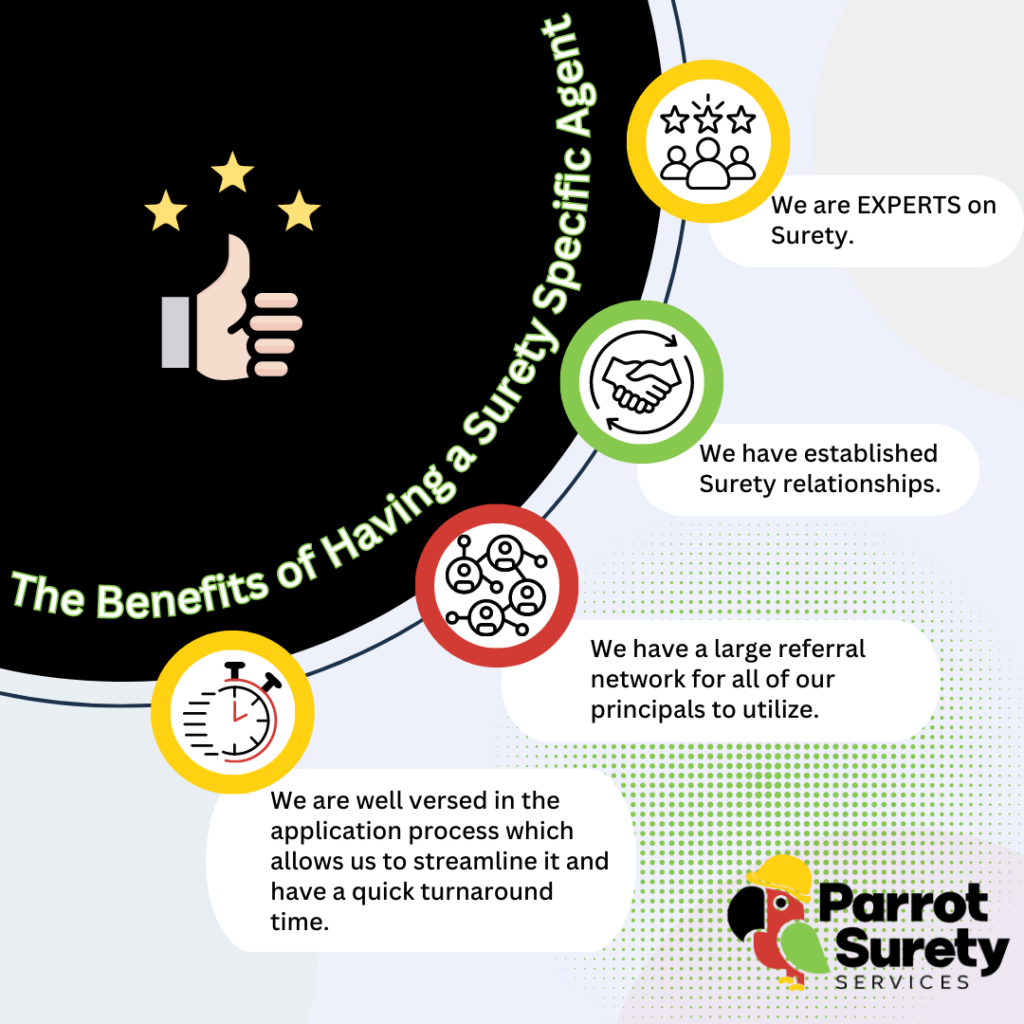
When it comes to navigating the world of surety bonds, contractors and principals can greatly benefit from the expertise and guidance of a surety-specific agent. Surety bonds are complex financial instruments that require in-depth knowledge and experience to navigate effectively. By partnering with a surety-specific agent, contractors and principals gain access to professionals who specialize in the intricacies of surety bonds. These agents understand the unique requirements of different industries and can provide tailored solutions to meet specific needs. From determining the right bond type and coverage to navigating the application process and securing competitive rates, a surety-specific agent can streamline the entire process and ensure that contractors and principals make informed decisions.
 
The benefits of using a surety-specific agent extend beyond just expertise. These agents have established relationships with multiple surety bond providers, giving contractors and principals access to a wide network of options. This access allows for greater flexibility in finding the most suitable surety bond provider for specific projects or contractual obligations. Surety-specific agents can leverage their relationships to negotiate competitive rates, ensuring that contractors and principals receive the best possible terms. Additionally, these agents can provide ongoing support, acting as a trusted advisor throughout the lifespan of the surety bond, assisting with bond renewals, and providing guidance in case of any potential claims or issues that may arise.
 
Another significant advantage is the speed of service. Surety-specific agents are well-versed in the application process and have a deep understanding of the documentation and requirements needed to obtain a surety bond quickly. This prompt service can be particularly beneficial when contractors need to secure bonds for time-sensitive projects or when principals require proof of bonding before granting a contract.
 
Our team at Parrot Surety Services is here for all of your surety bond needs. Contact any member of our team for dedicated surety expertise and support!
 

How to Get a Bond in 6 Easy Steps

Obtaining A Surety Bond In 6 Steps:
 
Step 1: Determine the Type of Surety Bond You Need
Identify the specific type of surety bond required for your situation. Surety bonds come in various forms, including construction bonds, license and permit bonds, court bonds, and fidelity bonds. Each bond type serves a unique purpose and is typically guided by statute. Ask your agent for help!

Step 2: Research Surety Agents
Look for reputable  agents that handle surety bonds regularly. Research online, ask for recommendations from industry peers, or consult the National Association of Surety Bond Producers’ website to find a surety producer near you. It’s crucial to work with a reliable provider who understands your needs and can get you competitive rates.

Step 3: Gather the Necessary Documentation
To apply for a surety bond, you’ll need to provide certain documentation. The exact requirements may vary depending on the bond type and provider, but commonly requested documents include:
→ Application 
→ Personal and business financial statements
→ Credit Report Authorization
→ Work history and references
Contract or Licensing/Permitting documents

Step 4: Submit your Application
Once you have the required documentation, submit your application to the chosen surety bond provider. Many providers offer online application systems, making the process quick and convenient. Ensure that all information provided is accurate and complete to avoid any delays in processing.

Step 5: Underwriting and Approval
After receiving your application, your surety agent will send your submission package to an underwriter who will assess your financial stability, creditworthiness, and overall risk. If approved, the provider will issue a quote or premium amount based on the bond type and your specific circumstances.

Step 6: Pay the Premium and Obtain the Bond
Upon accepting the quote, you will need to pay the premium amount. The premium is typically a percentage of the bond amount (1-5%). Once the payment is made, the surety bond will be issued, and you will receive the necessary documentation confirming your bond’s validity.
 
Our team at Parrot Surety Services is here for all of your surety bond needs. Contact any member of our team for dedicated surety expertise and support!
 

Costs, Benefits, and Considerations of Bid Securities for Contractors

Using Irrevocable Letters of Credit (ILOC), cash and cash equivalents, and surety bonds all serve as valid options when bidding on contracts. Each type of bid security carries distinct advantages and disadvantages, with varying implications for both the project owner and the bidder.

Irrevocable Letters of Credit (ILOC)

Pros
Fast Approval: Typically, quicker to obtain compared to a surety bond.
Strong Guarantee: The bank will pay as long as the conditions in the ILOC are met.
Flexible Terms: Customizable to align with the project owner’s needs.

Cons
Costly: Banks often charge fees for setting up and maintaining an ILOC.
Reduced Liquidity: The amount is usually blocked or deducted from your credit facility, affecting available capital.
Financial Risk: Banks may require collateral or impose strict covenants, which can limit your financial flexibility.

Cash and Cash Equivalents

Pros
Simplicity: No need for third-party involvement, simpler than obtaining an ILOC or surety bond.
Quick to Set Up: Generally faster to arrange compared to ILOCs and surety bonds.

Cons
Liquidity Impact: Requires an upfront payment in full, affecting your cash flow. The obligee is often slow to return the security.

No Earnings: The funds usually don’t earn interest while they are tied up.
Limited Scope: Offers fewer guarantees and protections for the project owner compared to surety bonds.

Surety Bonds

Pros
Comprehensive Coverage: Specifically designed for contract bidding, with detailed terms to cover various scenarios.

Relationship Leverage: Surety companies may offer better terms and have added legal support in the event of frivolous claims.

Minimal Cash Flow Impact: No cost to bid; if you’re low bidder, then it requires only a percentage (1% to 5%) of the bond amount upfront, leaving more of your cash flow intact. 

Cons
Qualification: Preparing your financials and undergoing a comprehensive financial review can be time-consuming.

Premium Costs: An additional expense, although generally lower than ILOC fees and currently cheaper than the cost of capital.

Limited Availability: Not all companies may qualify, particularly those with less established financial histories.

Considerations for Choice:

Cost: ILOCs and surety bonds have ongoing costs, while cash and cash equivalents tie up your capital upfront but generally have no additional fees.

Time Sensitivity: Cash and cash equivalents, along with ILOCs, are usually quicker to obtain compared to surety bonds.

Financial Impact: Both ILOCs and cash and cash equivalents can significantly affect your liquidity, whereas surety bonds have lesser impact.

Contract Requirements: Check the contract to see if there are stipulations about the type of bid security required.

Industry Norms: Industry standards may influence the preference for one type of bid security over another.

Risk Profile: Surety bonds often offer the most comprehensive protection for the project owner and the only security with prequalification, potentially making your bid more appealing.
Choosing the right form of bid security demands careful evaluation of your financial status, the project’s requirements, and the associated risks. If you’d like a surety bond quote for your company to compare the costs of your bid security, then look no further than our agents at Parrot Surety Services to provide a quote and guidance for improved terms and rates. 
 
Our team at Parrot Surety Services is here for all of your surety bond needs. Contact any member of our team for dedicated surety expertise and support!
 

Surety Bonds Myths/Misconceptions

1. Surety bonds are the same as insurance: While surety bonds and insurance may share some similarities, they are not the same. Insurance protects the insured party from unforeseen events and provides financial compensation in case of a loss. On the other hand, surety bonds are three-party agreements that guarantee the performance of a specific obligation or contract. In the event of a default, the surety bond provides compensation to the party that was harmed by the defaulting party.

2. Surety bonds are expensive and unaffordable: The cost of a surety bond is typically a percentage of the bond amount, known as the premium. The premium is influenced by various factors, such as the bond type, bond amount, the applicant’s financial stability, and creditworthiness. While the premium can vary, it is often reasonable and affordable for most businesses. Factors such as a strong financial history and good credit can help reduce the premium cost.

3. Only construction companies need surety bonds: While surety bonds are commonly associated with the construction industry, they are applicable in various other sectors as well. Surety bonds are often required in industries such as transportation, healthcare, finance, real estate, and retail, among others. They serve as a form of protection for obligees, ensuring that the bonded party fulfills their contractual obligations.

4. Surety bonds protect the principal (bonded party): One of the primary purposes of a surety bond is to protect the obligee, not the principal. The obligee is the party that requires the bond and seeks financial compensation in case of a default or non-performance by the bonded party. The surety bond provides a guarantee to the obligee that they will be compensated up to the bond amount if the bonded party fails to meet their obligations.

5. Obtaining a surety bond is a complex and time-consuming process: While the requirements for surety bonds vary based on the bond type and jurisdiction, the process is not inherently complex or time-consuming. Many surety bond providers have simplified the application process, allowing businesses to obtain bonds quickly and efficiently. However, certain bond types may have more stringent requirements, and larger bond amounts may require more extensive underwriting.
 
6. It’s important to note that the specifics of surety bonds can vary by jurisdiction and bond type. If you need a surety bond, it is advisable to consult with a reputable surety bond provider or an experienced professional in the field for accurate and tailored information.

Our team at Parrot Surety Services is prepared to help you secure a surety bond guarantee for any stage of waste management. Contact any member of our team for dedicated surety expertise and support!